
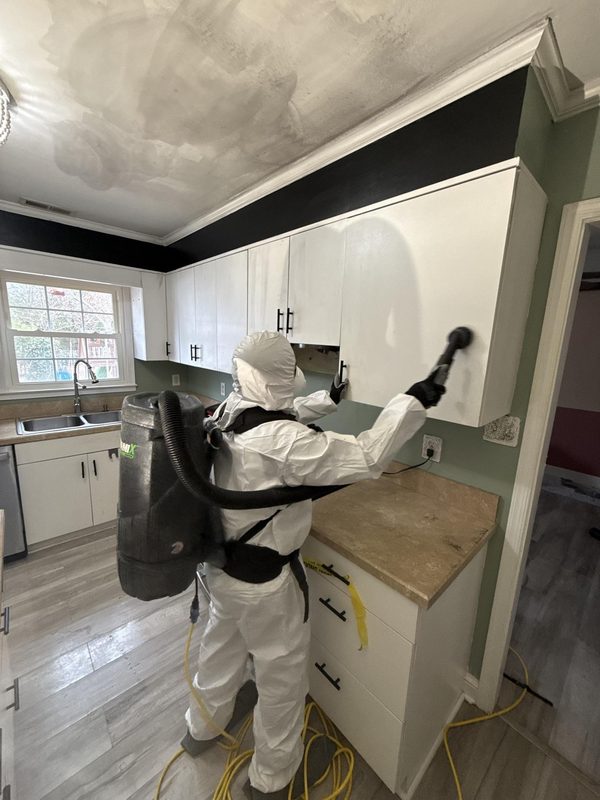
Cabinets are usually the most expensive single component damaged in a kitchen or bathroom water loss. They are also the part homeowners and adjusters disagree about most. Whether your cabinets can be dried in place, refinished, or have to come out entirely depends on three things: what they are built from, how long they were wet, and what category of water touched them. This guide walks through how our Las Vegas crews evaluate cabinet damage, what the IICRC S500 standard actually requires, and how to document everything so your claim is paid fairly.
If you are dealing with an active leak right now, stop reading and call us at (702) 605-2526. Every hour standing water sits against a cabinet base, the salvage odds drop. For ongoing reading, our water damage restoration page covers the broader emergency response process.
Why cabinets fail so fast in a Vegas water loss
Most Las Vegas tract homes built after 1995 use cabinet boxes made of particleboard or MDF with a thin laminate or thermofoil skin. These materials are engineered to be flat, dimensionally stable, and inexpensive. They are not engineered to get wet. Once water penetrates the laminate, even briefly, the substrate swells, the glue bond fails, and the panel loses structural integrity. By the time you see bubbling on a toe kick or a sagging sink base, the damage inside the cabinet box is usually well advanced.
Solid wood cabinets, common in custom Summerlin and Anthem builds and many older Henderson homes, behave very differently. Hardwood face frames, plywood boxes, and dovetailed drawer fronts can often be dried in place with focused airflow and dehumidification. The finish may need refreshing, but the cabinet itself is usually salvageable if we get to it quickly.
The fastest way to tell what you have: open a drawer and look at the unfinished edge. A speckled tan and brown core is particleboard. A smooth uniform brown is MDF. Visible wood grain layers are plywood. Solid wood throughout is solid wood. Salvage prospects improve dramatically as you move down that list.
Salvage vs replace: how we make the call
The IICRC S500 standard for professional water damage restoration does not give a single bright line for cabinets. It gives a framework, and the framework hinges on three variables.
- Water category. Clean supply line water (Category 1) gives the widest salvage window. Gray water from a dishwasher or washing machine (Category 2) is borderline and usually requires removal of porous interiors. Black water from a sewer backup or long standing flood (Category 3) means the cabinet boxes have to come out. See our guide to sewer backups in older Las Vegas homes for why Category 3 losses are so common in mid-century neighborhoods.
- Material. Solid wood and quality plywood: high salvage rate. Particleboard and MDF: low salvage rate, especially below the sink and along toe kicks where water pools.
- Exposure time. The IICRC considers any porous material wet for more than 48 hours at risk of microbial growth. Cabinets that sat wet over a weekend almost always have to come out at least partially, regardless of material.
The honest answer most homeowners do not want to hear: if you have particleboard cabinets and a Category 1 leak that was caught within a few hours, we can often save them with aggressive drying. If either of those things is not true, replacement is usually the right call, and pushing to dry in place often ends in a mold remediation a few months later. Our desert mold guide explains why hidden moisture in cabinetry is one of the most common sources of indoor mold complaints in Las Vegas homes.
What IICRC compliant cabinet drying actually looks like
When salvage is realistic, in place drying is not just pointing a box fan at the kickplate. A proper setup involves:
- Removing toe kicks and drilling small drying ports into the bottoms of sink bases and any cabinet that held standing water.
- Pulling drawers and shelves entirely so airflow can reach the back panels.
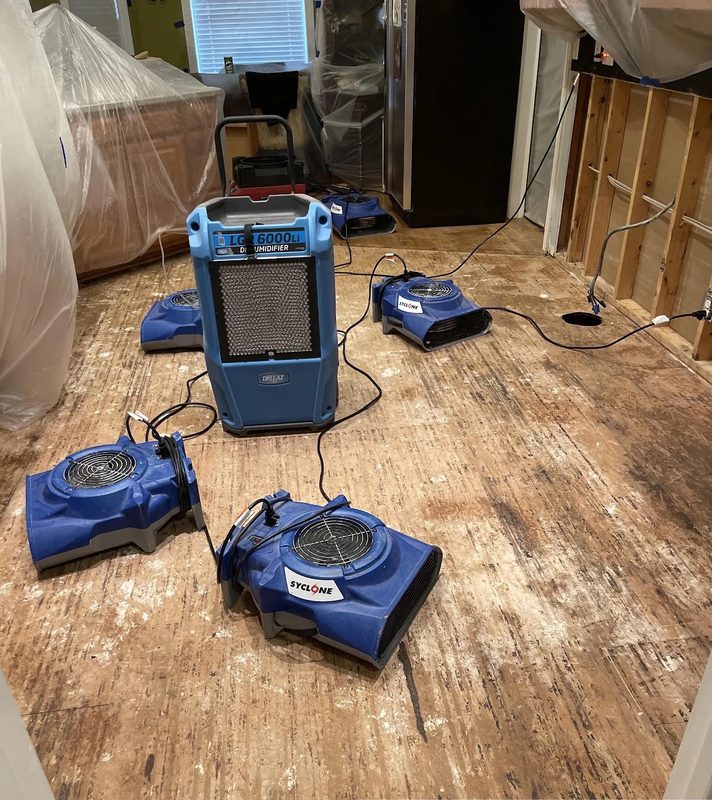
- Setting low grain refrigerant or LGR dehumidifiers sized to the affected area, not the whole house.
- Placing centrifugal air movers to create directed airflow through every cabinet bay.
- Daily moisture readings on the cabinet substrate, the wall behind, and the subfloor, logged with timestamps and shared with your adjuster.
We use penetrating and non penetrating moisture meters along with thermal imaging to find moisture you cannot see. A cabinet that looks dry on the surface can still be 25 percent moisture content in the core, which is far above the dry standard of around 12 to 15 percent for cabinetry. Pulling equipment too early is the most common cause of cabinet related mold callbacks. See our structural drying service page for more on the equipment and process.
When fire damage is involved
Kitchen fires bring a second layer of complication: smoke, soot, and the water used to extinguish the fire. Cabinets above and beside a range fire are usually a total loss not because of heat damage, but because soot penetrates wood pores and the lingering odor is nearly impossible to seal. Cabinets further away can sometimes be cleaned, deodorized, and refinished. We cover the full process in our Las Vegas kitchen fire recovery guide.
The salvage rules from the water section still apply, layered with smoke residue testing. Particleboard cabinets that absorbed both fire suppression water and protein smoke residue are almost never worth saving. Solid wood cabinets ten feet from the fire often are.
Insurance documentation that gets cabinet claims paid
Adjusters approve what they can see and verify. Cabinet replacement is one of the line items most likely to be reduced or denied, so documentation matters. On every job we deliver:
- Wide and tight photographs of every affected cabinet, inside and out, before any work begins.
- Moisture readings logged at the start, every day during drying, and at completion.
- Material identification notes (particleboard, MDF, plywood, solid wood) for each cabinet section.
- Manufacturer and model information when available, so like for like replacement can be priced accurately.
- An Xactimate scope of work delivered directly to your adjuster in the format they expect.
For more on working with adjusters, the Nevada Division of Insurance publishes a useful overview at doi.nv.gov. If you are an adjuster reading this, our insurance partner page outlines how we document and submit claims.
What it usually costs in Las Vegas
Cabinet related restoration cost in the Vegas market falls into a few rough buckets. These are general 2026 ranges from jobs we have completed, not quotes:
- In place drying of a sink base and one adjacent cabinet, Category 1 water: roughly $600 to $1,200 in drying labor and equipment.
- Removal and disposal of a damaged sink base plus replacement of the box only, builder grade: roughly $900 to $1,800 installed.
- Full kitchen cabinet replacement after a Category 2 or 3 loss, mid range materials: typically $14,000 to $35,000 depending on layout, countertops, and whether plumbing or electrical has to be rerouted.
- Vanity replacement in a single bathroom: roughly $700 to $2,500 installed for a standard size.
These are the cabinet related costs only. They do not include flooring, drywall, paint, or contents. A full kitchen loss claim almost always includes those line items as well.
If you are deciding right now
Three quick decisions tonight will protect your salvage odds and your claim:
- Shut the water off at the angle stop or the main, and remove everything from the affected cabinets so air can move.
- Take wide and close photos before you move anything you do not have to. Adjusters value pre disturbance photos.
- Call a certified restoration company, not a handyman. Insurance carriers expect IICRC documentation and many will not reimburse non certified drying.
We are based in Las Vegas, family owned, and answer the phone 24/7. If your cabinets are wet, we can usually have a crew on site within an hour anywhere in the valley. For weak coverage neighborhoods like North Las Vegas, Centennial Hills, and Aliante, see our service area pages for more local detail.
Frequently asked questions
Will my homeowners insurance cover cabinet replacement after a leak?
If the water loss itself is covered (a sudden burst pipe, an appliance failure, a roof leak from a storm), the resulting cabinet damage is almost always covered up to your policy limits. Slow long term leaks and maintenance issues are typically excluded. Our slab leak guide explains why catching leaks early matters for both salvage and coverage.
Can I just dry the cabinets myself with fans?
You can move air, but a household fan will not remove moisture from the room. Without a properly sized dehumidifier, you are just relocating water vapor that condenses somewhere else in the cabinet. You also will not have the moisture documentation your insurance carrier needs.
How long does in place cabinet drying take?
Typically three to five days with continuous equipment, depending on saturation level. We document daily and pull equipment only when readings hit dry standard, not on a fixed schedule.
What if mold is already growing inside the cabinets?
That changes the scope from water mitigation to mold remediation. Containment, HEPA filtration, and removal protocols apply. See our mold remediation service page for the full process.
Do you handle the cabinet rebuild after demo?
Yes. We coordinate the full restoration through reconstruction, including cabinet ordering, install, countertop coordination, and final punch list. You deal with one company from emergency call to keys back.