
Roughly half the single family homes across the valley have pools, and almost all of them lose water to evaporation in the summer heat. The hard part is telling normal evaporation from a real leak. A leak that goes unaddressed for months can saturate the soil under your pool deck, shift the bond beam, or migrate against the house foundation and cause an interior slab leak.
This guide gives you the bucket test (which separates evaporation from leakage in 24 hours), explains where pool leaks become house damage, and covers how restoration handles water that has reached the structure.
How much evaporation is normal
A typical uncovered pool in the Las Vegas Valley loses roughly 1/4 to 1/2 inch per day to evaporation in the summer, less in cooler months. If your pool is dropping more than 1 inch per day, or you are adding water multiple times a week to keep it level, you almost certainly have a leak.
The bucket test (do this first)
Before calling anyone, run a bucket test to separate evaporation from a real leak.
- Set a 5 gallon bucket on the second pool step and fill it with pool water to match pool level.
- Mark both the bucket and the pool waterline.
- Wait 24 hours with the pump running normally.
- If the pool dropped more than the bucket, the difference is leak loss.
- Repeat with the pump off. A bigger drop with the pump off points to a return line; bigger with pump on points to a suction line or skimmer.
When pool leaks become house damage
Most pool leaks just lose water into the soil. A few become real problems for the structure.
- Plumbing leaks under the deck saturate caliche soils, which can shift the deck and crack the bond beam.
- Leaks against the house foundation push water under the slab, which is how pool plumbing causes interior slab leaks.
- Pool equipment pad leaks (filter, heater, valves) flood adjacent garages and casitas.
- Cracked bond beams allow surface pool water to wick into adjacent walls.
Restoration scope when water reaches the structure
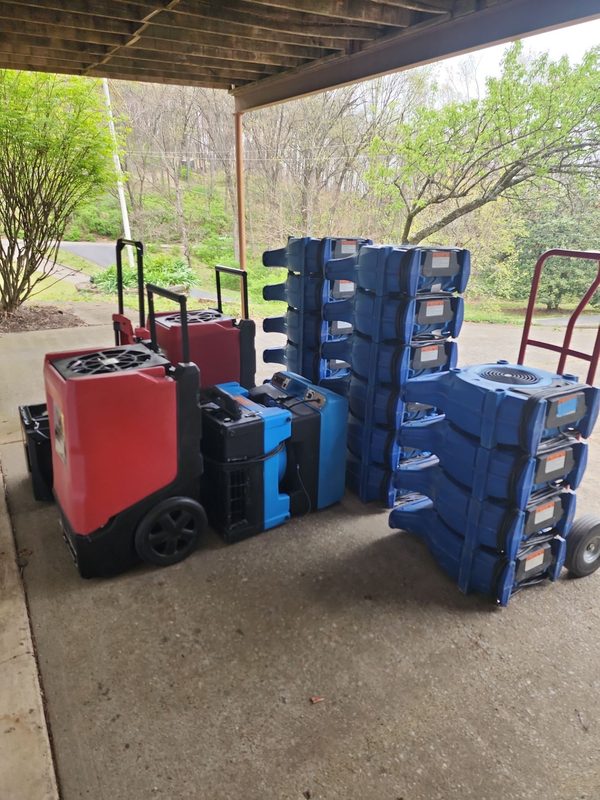
If pool water has migrated under the slab or into a wall cavity, fast extraction and drying is the same as any clean water (Category 1) loss. Pool chemistry (chlorine, salt, cyanuric acid) typically does not change the drying protocol but can affect what materials are salvageable. Hardwood flooring near a leaking pool deck usually has to come out.
When a pool plumbing leak becomes an interior slab leak
Pool plumbing typically runs in trenches alongside or under the deck, sometimes within feet of the house foundation. A pinhole leak in a return line at 25 to 35 PSI loses water continuously into the soil. Caliche soils saturate, lose some load bearing capacity, and pressure shifts toward the foundation. Water then migrates under the slab into the house, usually showing up at the lowest baseboard along an exterior wall.
By the time a homeowner sees that interior baseboard staining, they often think it is an interior plumbing leak. Pinpointing the actual source requires testing the pool plumbing in isolation, which a leak detection plumber can do in an afternoon.
Need professional help with this in Las Vegas or Clark County? Our IICRC-certified crews respond 24/7.
Call (702) 605-2526