
Most newcomers assume Las Vegas does not flood. Long time residents know better. Every July and August, the North American Monsoon parks moisture over the valley and dumps it in concentrated bursts, often more than the entire annual rainfall in a single afternoon. The valley's flood control system handles most of it, but the tail end of the bell curve still puts homes underwater in the same neighborhoods every season.
This guide is the practical version: where the valley actually floods, what to do before the season, how to act in the first hour after water gets in, and what your insurance does and does not cover. It is written for homeowners in North Las Vegas, Centennial Hills, Sunrise Manor, east Henderson, Spring Valley, and anywhere else that sits near a wash, a low spot, or a detention basin.
Why monsoon storms hit Las Vegas so hard
Between roughly mid-June and late September, moisture pulled up from the Gulf of California collides with desert heat over the Spring Mountains and Sheep Range. The result is short, violent thunderstorms that can drop a half-inch to two inches of rain in under an hour. Because the valley floor is hardpan caliche covered with pavement, almost none of that water soaks in. It runs.
Las Vegas was built with one of the most engineered flood control systems in the country, but the system is sized for the average storm, not the outlier. When a cell trains over the same wash for 30 minutes, detention basins fill, channels overtop, and water finds the lowest point of the nearest neighborhood.
Where the valley floods most
Crews see repeat flooding in the same handful of areas every season. If you live in one of these neighborhoods, treat monsoon prep as non-optional.
- North Las Vegas along the Las Vegas Wash and Gowan Outfall, including Aliante, Tule Springs, and the Craig Road corridor.
- Centennial Hills and the upper Kyle Canyon Wash drainage near the 215 Beltway.
- Sunrise Manor and the Las Vegas Wash through the east valley near Nellis and Lake Mead Boulevard.
- Older sections of east Henderson around Boulder Highway and the C-1 Channel.
- Lower Spring Valley and Chinatown around the Flamingo Wash crossings.
Pre-monsoon prep: a one afternoon checklist
Most claims we run during monsoon season trace back to two or three preventable conditions. Walk your property once in late May and you will eliminate most realistic risk.
- Clear scuppers, canales, and roof drains. Tile and flat roofs in the valley clog with palm fronds and dust crust.
- Reseal flat-roof penetrations and parapet flashings. Most monsoon roof leaks are at HVAC curbs and skylights.
- Confirm grading slopes away from the foundation for the first six feet. Decomposed granite settles every year.
- Check that yard drains and area drains in side yards are clear, not packed with rock and leaves.
- Photograph valuable contents in garages and ground-floor rooms. If you flood, the claim moves faster.
- Move stored cardboard, electronics, and seasonal items off garage floors onto pallets or shelving.
What to do in the first hour after water gets in
Acting fast is the single biggest variable in how much your loss costs. Drywall, baseboards, and flooring that sit wet overnight usually have to be removed. The same materials addressed inside two hours often dry in place.
- Cut power to any circuit where water is touching outlets, lights, or appliances.
- Move wet contents to a dry area to keep dye transfer off carpet and pad.
- Photograph and video everything before you move or clean anything.
- Call your insurance carrier and a 24/7 IICRC certified restoration company at the same time.
- If the source is still active (a stuck downspout, a backed up area drain), divert it before extraction starts.
What insurance covers and what it does not
This is where many Las Vegas homeowners get a hard surprise. Standard homeowner policies cover sudden internal water damage like a burst pipe, but they exclude surface water and rising water that comes in from outside. That includes monsoon runoff entering through a garage door, sliding door track, or low window well.
Coverage for surface flooding requires a separate flood policy through the National Flood Insurance Program (NFIP) or a private flood insurer. If your home is anywhere near a wash, channel, or detention basin, look up your flood zone on the FEMA Flood Map Service Center and price a policy. Annual premium is often less than a single restoration deductible.
Why fast extraction matters in the desert
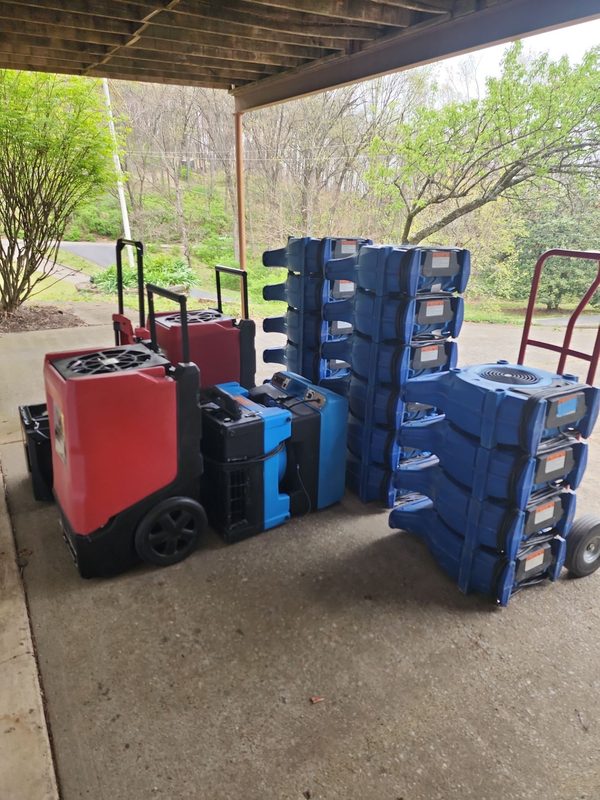
Vegas humidity is normally low, which helps drying timelines once equipment is set. The catch is that monsoon humidity spikes hard during the storm and stays elevated for 24 to 48 hours after, especially with closed windows and the AC fighting moisture load. Without commercial dehumidifiers running on day one, mold colonies can begin inside drywall cavities within 48 hours even in the desert.
How the valley flood control system works (and where it does not)
The Clark County Regional Flood Control District operates more than 600 miles of channels and over 100 detention basins designed to capture and meter monsoon runoff before it reaches developed neighborhoods. The system has dramatically reduced flooding over the past 30 years, but it is sized for a design storm, not the 100 year cell that occasionally trains over the same wash for an hour.
When that happens, water overtops channel walls, fills detention basins past capacity, and finds the lowest point in the nearest neighborhood. Homeowners in newer master planned communities are usually well protected. Homes in older sections built before modern grading standards (large parts of North Las Vegas, Sunrise Manor, and Whitney) take repeat hits.
What carriers actually pay for after a monsoon flood
The dividing line is whether water entered from inside the building (covered) or from outside (excluded). A wind driven rain event that pushed water through a tile roof and into the attic is generally covered. Water that flowed across your driveway into the garage is not, regardless of how heavy the storm was.
If your home has flooded from surface water before, document everything in writing, talk to your agent about a private flood policy (some private flood carriers cover homes outside FEMA flood zones at modest annual cost), and prepare yourself emotionally for a rough conversation if you only carry standard coverage.
The bottom line
Monsoon flooding is the single most common large insurance loss in the Las Vegas Valley, and it is largely predictable. If you live in a known flood-prone neighborhood, prep your home in May, get the right insurance coverage, and have a 24/7 restoration company saved in your phone before the season starts. The first hour after water gets in is what decides whether your loss is small or significant.
Flooded after a monsoon storm? Our IICRC certified Las Vegas crews extract, dry, and document for your carrier 24/7.
Call (702) 605-2526